What Is a Good Tip Percentage? The Complete 2026 Tipping Guide
You finish dinner, the bill arrives, and then you're staring at a payment terminal showing buttons for 18%, 22%, 25%, and "Custom" in a slightly smaller font, as if "custom" means something shameful. Tipping etiquette has shifted fast in recent years — higher default prompts, tip screens at counters that have never asked before, delivery apps defaulting to 20%. If you're not sure what's genuinely expected anymore, this guide covers exactly that, broken down by service type.

Quick Reference: Standard Tip Percentages by Service (US)
| Service | Minimum | Standard | Excellent |
|---|---|---|---|
| Sit-down restaurant (server) | 15% | 18–20% | 25%+ |
| Bar / bartender | $1/drink | 15–20% | 20–25% |
| Food delivery (app) | 10% | 15–20% | 25%+ |
| Takeout / counter service | 0% | 10–15% | 15–20% |
| Taxi / rideshare | 10% | 15–20% | 20–25% |
| Hair / salon services | 15% | 20% | 25%+ |
| Hotel housekeeping | $1–2/night | $3–5/night | $5+/night |
| Hotel concierge / bellhop | $1–2/task | $3–5 | $5–10 |
| Spa / massage | 15% | 20% | 25% |
| Food truck / casual counter | 0% | 10% | 15% |
| Coffee shop (barista) | 0% | $0.50–$1 | 15–20% |
Why 20% Has Become the New Standard
Through most of the 20th century, 15% was the standard restaurant tip in the United States. The shift to 18–20% as the baseline happened gradually through the 2010s. Several factors drove this:
- Inflation: The real value of a fixed percentage tip declines as labour costs rise, pushing expected percentages upward.
- Wage structures: In most US states, servers can legally be paid below minimum wage with the expectation that tips make up the difference. The federal tipped minimum wage has remained at $2.13/hour since 1991 (though many states have higher floors).
- Digital default prompts: Payment terminals that default to 18%, 20%, and 25% have normalised higher starting points — the "skip" option feels like an explicit refusal.
The practical rule: 15% says "service was acceptable." 20% says "good service, thank you." 25%+ says "you made this experience special." Anything below 10% at a sit-down restaurant reads as a statement of dissatisfaction rather than a tip.
Should You Tip on the Pre-Tax or Post-Tax Amount?
Technically, the etiquette guides recommend tipping on the pre-tax subtotal. The reasoning: the waiter didn't provide the tax, so why reward them for it?
In practice, the difference is small. On a $60 bill with 8% tax ($4.80), the difference between tipping on $60 vs. $64.80 at 20% is about $0.96. Most people tip on the total for simplicity, and most servers don't care which you use — the dollar difference is negligible.
How to Split the Tip When Paying as a Group
When splitting a bill, there are two common approaches:
- Tip on the full bill first, then split: Add 18–20% to the total bill, then divide equally. This is simpler and often results in a slightly larger tip for the server (accounting for the work of managing a group).
- Each person tips on their portion: More precise but harder to calculate. Use our tip calculator for quick per-person amounts.

The Rise of "Tip Creep": When Is Tipping Expected Now?
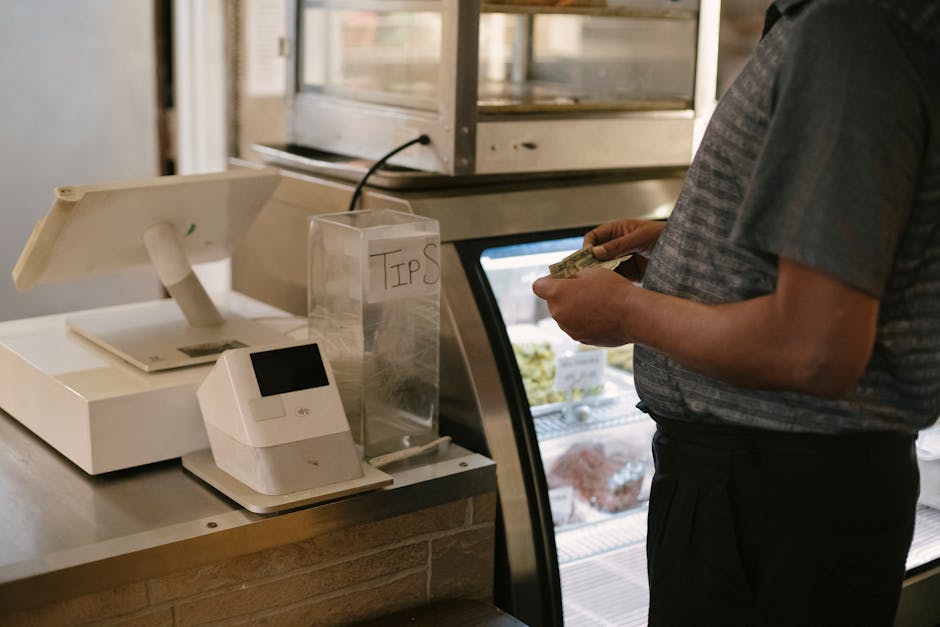
Tip prompts now appear in places that were tip-free as recently as five years ago: self-checkout kiosks, coffee shop drive-throughs, online ticket purchases, and retail checkouts. This expansion of tipping culture has created genuine confusion about what's obligatory vs. optional.
Here's a simple framework:
- Personal service provided: Tipping is appropriate and appreciated (haircuts, massages, food delivery).
- Counter or self-service: Tipping is optional — a kind gesture but not an obligation (coffee, fast food, retail).
- Automated or no human interaction: No expectation to tip (self-checkout machines, vending).
International Tipping: Where Not to Tip
Tipping norms vary enormously by country. What's polite in New York can be confusing or even insulting in Tokyo.
| Country / Region | Restaurant Tip | Notes |
|---|---|---|
| USA | 18–20% | Expected; servers rely on tips |
| Canada | 15–20% | Similar to US |
| UK | 10–15% | Optional; check if service charge included |
| Australia | 0–10% | Not expected; minimum wage is high |
| Japan | 0% | Can be seen as rude — service is included |
| South Korea | 0% | Not customary |
| France | 5–10% | Service charge ("service compris") often included |
| Germany | 5–10% | Round up the bill; discretionary |
| Mexico | 10–15% | Expected at sit-down restaurants |
Always check whether a service charge has already been added to your bill — some UK and European restaurants include 12.5% automatically. Tipping on top of a mandatory service charge is entirely optional.
Calculate the exact tip, total, and per-person split in seconds.
Use the Free Tip Calculator →